
Stop manpower shortages and site accidents through Mental Health First Aid and QPR Certifications.
Safety is your #1 priority, but the most significant threats to your project timeline often happen before a worker even steps onto the scaffolding. Mental health challenges are the “silent safety crisis” driving the industry’s manpower shortage.
The annual cost per employee experiencing untreated mental distress.
Of construction workers reported anxiety or depression in 2025, a direct driver of site "near-misses."
5x as many construction workers lose their lives to suicide compared to all other site fatalities combined

Use the National Safety Council’s calculator to see exactly how mental health challenges are impacting your specific workforce.
services
MHFA is a skills-based, evidence-based public education training program that equips individuals to identify, understand, and respond to signs and symptoms of mental health or substance use challenges. Trusted nationwide: More than 4 million people have completed MHFA training, led by thousands of certified instructors
QPR (Question, Persuade, Refer) operates exactly like CPR for the mind. This rapid, evidence-based training equips construction supervisors, foremen, and field crews with three simple steps to intercept a mental health crisis before it leads to disaster. In an industry facing disproportionately high suicide rates, QPR provides your workforce with the immediate, actionable safety tools needed to identify distress, start a life-saving conversation, and connect a teammate to appropriate care.
Expand employees' knowledge of signs, symptoms, and risk factors of mental health challenges.
Our training prioritizes active skill-building, ensuring your team leaves with the immediate confidence to apply evidence-based support in high-pressure environments.
Equip your team with the competency to recognize mental health challenges and provide high-quality resource referrals, ensuring support remains supportive, professional, and within appropriate workplace boundaries.
MHFA can be brought to your organization virtually or in-person.
MHFA can be brought to your organization virtually or in-person.
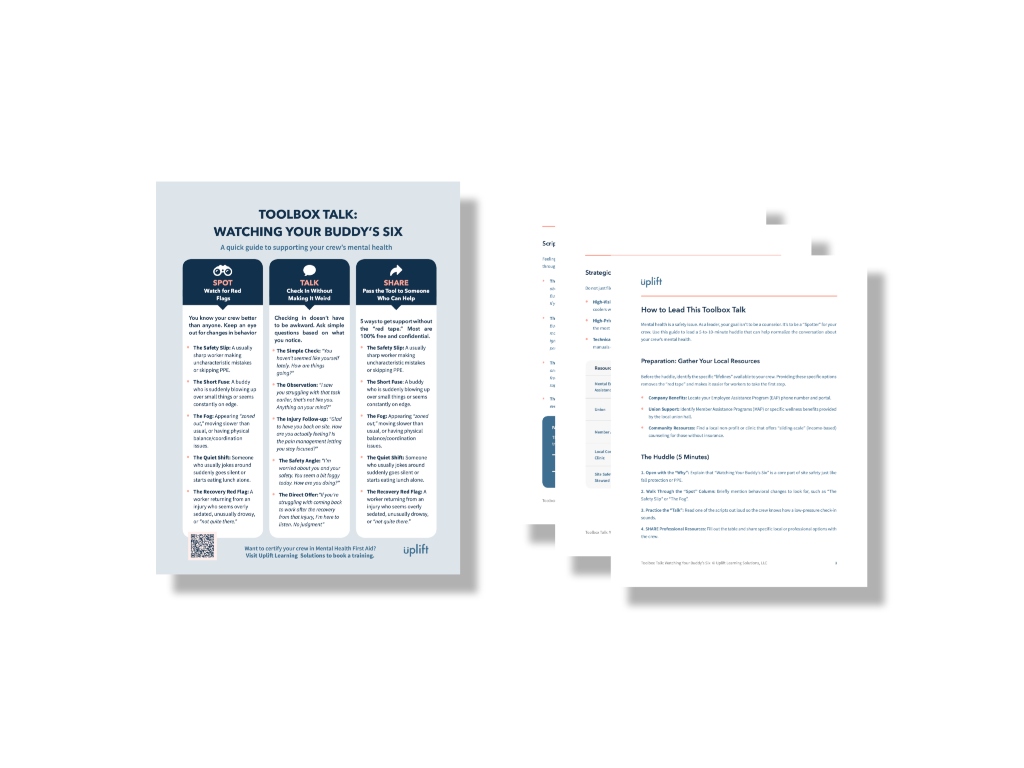
At Uplift Learning Solutions, we believe that site safety and productivity are built by equipping teams with the tactical tools to support mental health. Our “Watching Your Buddy’s Six” resource bridges the gap between physical PPE and mental readiness by providing a site-ready guide for leaders. This download includes operational instructions and actionable scripts to help foremen lead high-impact huddles without the “red tape,” alongside professional flyers designed for break areas to encourage discreet access to support.
Think of Mental Health First Aid (MHFA) as a comprehensive first aid course. It teaches your team how to identify, understand, and respond to a wide variety of mental health and substance use challenges over time. QPR (Question, Persuade, Refer) is an emergency intervention tool akin to CPR. It focuses intensely on a single, critical objective: recognizing an immediate suicide crisis and safely directing that individual to professional help. Both are vital, complementary pieces of a robust safety culture
The length of training varies based on the delivery format:
Virtual: 7.5 hrs | In-Person: 9.5 hrs (includes
2 hours self-paced prep)
Specialities such as MHFA for Veterans will add an additional hour.
Unlike the full-day commitment required for MHFA, a standard QPR Gatekeeper certification course is highly efficient, typically taking 60 to 90 minutes. This makes it incredibly easy to fit into safety meetings, leadership stand-ups, or weather-delayed downtime without disrupting your project schedules.
Because suicide rates in the construction industry are disproportionately high, everyone benefits from being a Gatekeeper. However, we highly recommend prioritizing project managers, foremen, superintendents, and safety directors, the people who interact with your field crews daily and are best positioned to notice changes in behavior.
To maintain the quality of the certification, we recommend groups of 15–30 employees.
Yes, our Communication Kit provides
ready-to-use emails, images, and flyers to boost sign-ups. You will also receive a press release template.
While our company is based in Chicago, we can provide training anywhere. We typically travel onsite to company offices or can arrange meeting space.
While we cannot guarantee premium reductions, many insurers recognize proactive mental health and safety training as a factor in lowering overall site risk and improving Experience Modification Rates (EMR).
Also, depending on your state, we may be able to help get funding for the training. For example, in Illinois, up to 50% of the training may be reimbursed through the ETIP program. Contact us for more details.